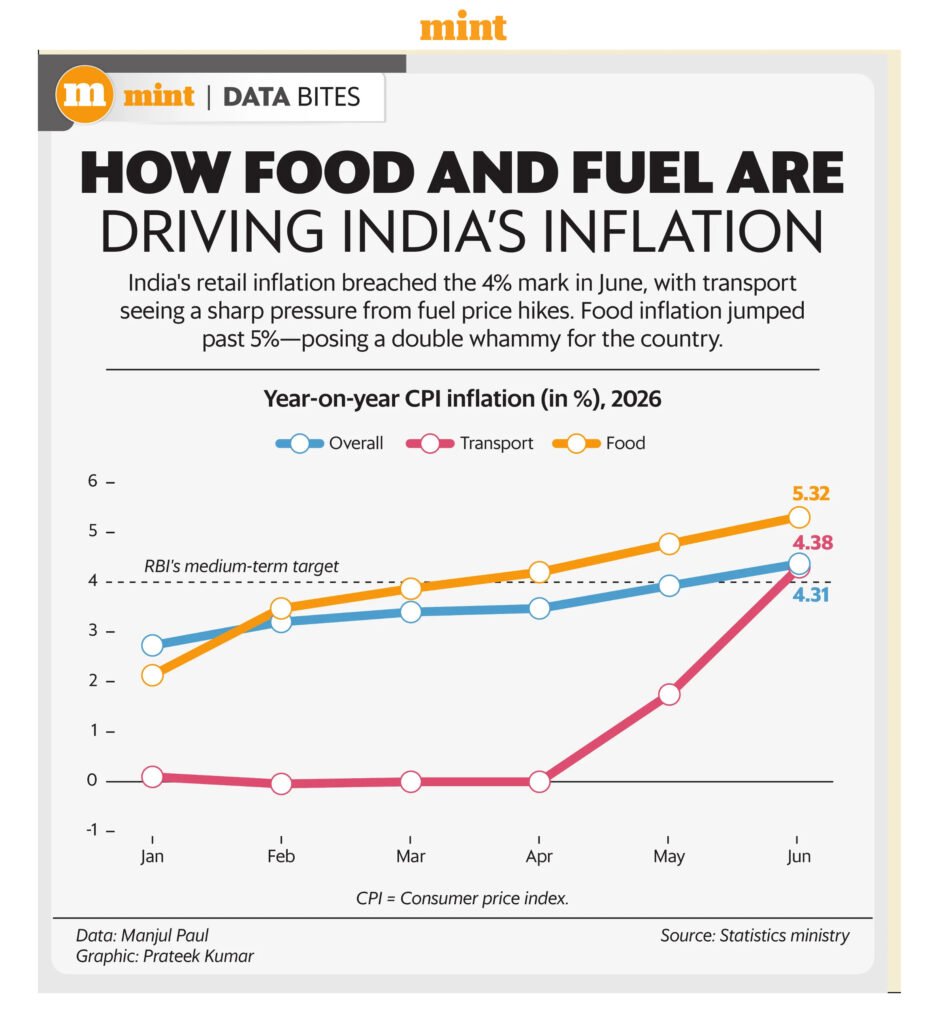

India’s retail inflation has remained below the Reserve Bank of India’s (RBI) 4% target in recent months, supported by a significant moderation in food prices. The easing of inflation has provided some relief to households and has strengthened expectations that the central bank may have more room to support economic growth. However, rising global crude oil prices are emerging as a key risk that could alter the inflation trajectory in the months ahead.
While food inflation has cooled after last year’s weather-related supply disruptions, higher fuel prices have the potential to feed into the prices of goods and services across the economy. India imports more than 85% of its crude oil requirement, making domestic inflation particularly vulnerable to geopolitical tensions and fluctuations in international energy markets.
Unlike many advanced economies, where policymakers and economists closely monitor “core inflation”—which excludes food and fuel because of their volatility—such a measure has limitations in India. Food alone accounts for nearly half of the Consumer Price Index (CPI) basket, reflecting its importance in household expenditure, especially for lower- and middle-income families. As a result, headline inflation often provides a more realistic picture of the financial pressure faced by Indian consumers.
Another concern is the second-round impact of higher fuel prices. Transportation costs are embedded in almost every product and service—from vegetables transported across states to airline tickets, app-based cab rides, courier services, manufactured goods and food delivery. As businesses face higher logistics and operating costs, they often pass at least part of the burden on to consumers. These effects usually emerge with a lag, meaning inflationary pressures can persist even if crude oil prices stabilize.
Economists also point out that rising energy costs affect industry beyond transportation. Manufacturing sectors such as cement, steel, chemicals, plastics and fertilizers are energy-intensive, and prolonged increases in fuel and energy prices can push up production costs. This, in turn, could raise prices across sectors ranging from housing and automobiles to consumer goods.
The impact is likely to be particularly significant for lower-income households, where expenditure on food, cooking fuel and transport forms a substantial portion of monthly budgets. Even a modest increase in the prices of essential commodities can erode purchasing power and affect discretionary spending, potentially slowing demand in other sectors of the economy.
For businesses, the challenge lies in balancing higher input costs with consumer demand. Companies operating in highly competitive markets may initially absorb some of the increased costs to protect market share. However, if elevated fuel prices persist, firms may eventually be forced to revise prices, contributing to broader inflationary pressures.
The Reserve Bank of India will therefore continue to monitor not only domestic food prices and the progress of the monsoon but also developments in global crude oil markets, exchange rate movements and geopolitical events that could affect energy supplies. While inflation currently remains within the central bank’s comfort zone, any sustained increase in fuel prices could complicate monetary policy decisions in the coming months.
For now, India’s inflation outlook remains relatively favourable compared with many major economies. However, policymakers will be keenly watching whether higher energy costs begin to offset the gains made through softer food inflation. The coming months will be crucial in determining whether inflation remains comfortably within the RBI’s target range or starts to edge higher once again.