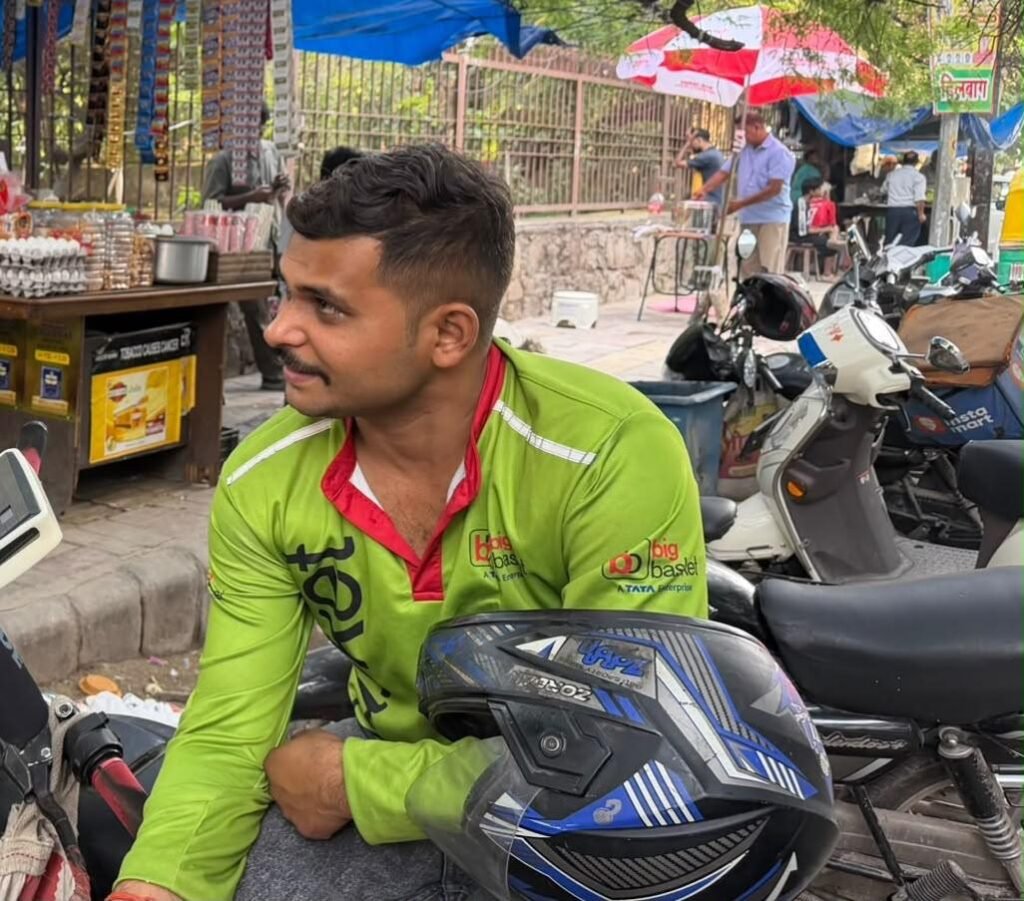
Ashish Misra is 24. A delivery worker with BigBasket, he puts in 14–16 hours a day, braving Delhi’s scorching heat and chaotic traffic. He earns around ₹30,000 a month while repaying EMIs and supporting his young family.
I spent an entire day with Ashish while reporting a story on the lives of delivery workers. Originally from Ayodhya, Uttar Pradesh, he lives with his wife and young child in Sangam Vihar, Delhi. I expected to find a makeshift dwelling with little beyond the bare necessities. Instead, his modest home had a refrigerator, a water purifier, a television and even a small air conditioner.
I was surprised. He wasn’t. “Everybody’s standard of living is improving,” he told me.
His experience reflects a larger economic change documented by the World Bank. Its poverty estimates show that the proportion of Indians living below the lower-middle-income poverty line of $4.20 a day fell from 57.7% in 2011–12 to 16.1% in 2023–24. This represents approximately 496 million fewer people living below that poverty threshold. Extreme poverty, measured at $3 a day, also declined from 27.1% to 2.6%. These are significant improvements, although poverty, inequality and insecure employment remain serious challenges.
Ashish’s aspirations were equally revealing. He wants to save enough money to return to his village, open a small shop and educate his child there. With electricity and internet connectivity available, he believes he can build a better life back home rather than spend his days negotiating Delhi’s congested streets.
There was another revealing aspect of my conversation with Ashish. When I brought up the political debates around ‘Vote Chori’ and the Special Intensive Revision (SIR) of electoral rolls, he was largely unaware of what I was talking about. Not because these issues are unimportant, but because his everyday reality is very different. He works 14–16 hours a day, worries about his EMIs and thinks about saving enough to return to his village. His immediate concerns are earning a living and securing his child’s future.
That, perhaps, illustrates the disconnect between the political discourse dominating television studios and rallies and the everyday priorities of millions of ordinary Indians.
His story is not one of hardship disappearing, but of aspirations changing. It left me wondering: Are we, in the heat of our political arguments, paying enough attention to the India that is changing quietly, one household at a time?
The point is not to suggest that everything is well or that the government deserves all the credit. Development comes through government policies, private enterprise, infrastructure, technology and individual enterprise. Progress, wherever it happens, must be acknowledged. Equally, the remaining gaps must be addressed.
Nor does poverty have a religious identity. A poor Hindu and a poor Muslim have much the same concerns: employment, education, healthcare and a secure future. Welfare and development must reach people irrespective of religion.
India’s political debate needs to engage with both realities: the millions still struggling and the millions whose lives and aspirations are changing. Jobs, incomes, education, healthcare and economic opportunity deserve as much attention as electoral politics and political slogans.
People do not live by political slogans alone. They want a better life. And perhaps that is the India we need to understand better.