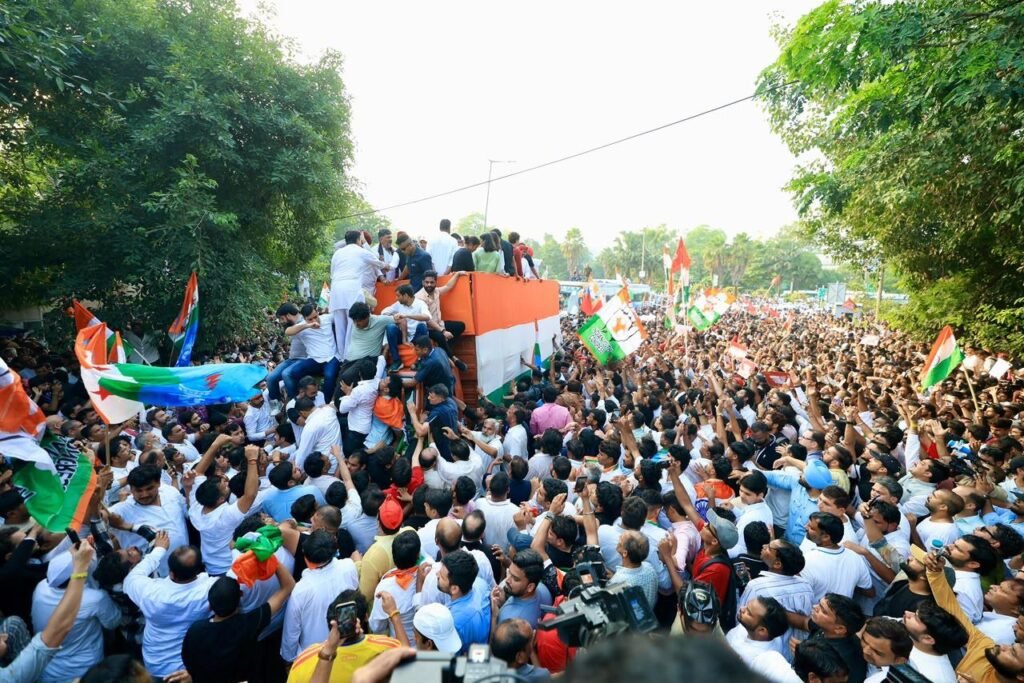

India is witnessing protests over a range of issues, but a larger political question remains: where is the expanding middle class in this debate? Is it joining the protests, quietly dissatisfied, or judging the government by a different yardstick — delivery, development and economic opportunity?
The answer matters because India’s middle class is no longer a marginal electoral constituency. A study by People Research on India’s Consumer Economy (PRICE) and Tata Sons, The Many Urban Indias, finds that middle-income households earning ₹6 lakh to ₹36 lakh annually accounted for 53% of households in the country’s 100 largest cities, up from 29% a decade ago. Their share is projected to reach 60% by 2030–31.
These numbers describe not just a growing consumer market, but a potentially important political constituency. Yet it would be a mistake to assume that such a diverse population thinks or votes as one.
A household earning ₹12 lakh in Raipur faces a very different economic reality from one earning the same amount in Mumbai. For both, however, employment, inflation, education, healthcare, housing and financial security can shape their assessment of the government.
The politics of aspiration
The middle class is driven by aspiration, but also by vulnerability. It wants better homes, cars, quality education, holidays and financial independence. At the same time, it is exposed to rising living costs, uncertain employment and the burden of private healthcare and education.
This creates a political paradox. A family may appreciate new highways, improved connectivity and digital public services, yet remain dissatisfied if its income does not keep pace with expenses. Development on the ground matters, but so does the ability to afford the life that development promises.
The middle class may not always protest on the streets, but its silence should not automatically be interpreted as satisfaction.
Some citizens express their discontent through demonstrations. Others participate in elections, discuss politics within their communities or simply reassess their support for a government. Many may do all three at different times.
Nor should protesters be dismissed as unrepresentative of ordinary Indians. Their concerns may reflect genuine grievances, even if they do not speak for the entire middle class. Equally, those who do not protest should not automatically be considered supporters of the establishment.
The important political question is whether governments understand this distinction between visible protest and less visible public dissatisfaction.
Can economic delivery translate into political support?
Governments are often judged by their ability to deliver tangible improvements: better roads, reliable electricity, cleaner cities, efficient public transport, accessible public services and more employment opportunities.
But delivery is not simply about building infrastructure. Citizens also want to know whether economic growth is improving their own lives. A new expressway may be an achievement, but a young graduate struggling to find a suitable job may judge the economy differently.
The middle class therefore presents governments with a more complex challenge than simply delivering headline growth. Its expectations rise as its incomes, education and exposure to the wider world increase.
And there is no guarantee that economic development alone will determine voting behaviour. Political leadership, identity, welfare programmes, local candidates and regional concerns also matter. The middle class is neither a guaranteed supporter of the government nor an automatic constituency for the opposition.
The economic stakes
This political argument has a direct economic consequence. The same households that evaluate governments at the ballot box are also the consumers businesses hope to attract.
India’s expanding middle-income population represents enormous potential demand for homes, cars, appliances, financial services and travel. But aspirations do not automatically translate into purchases. Households worried about jobs, education costs, medical expenses or inadequate savings may postpone discretionary spending.
For foreign investors, a large market is attractive only when accompanied by predictable policies, efficient administration, reliable infrastructure and confidence in the business environment. A stable government matters, but so does its ability to deliver.
India needs simpler regulations, faster approvals and a genuine single-window clearance system. Above all, it needs economic growth that creates jobs and enables households to spend without compromising their financial security.
The question India must confront
India’s expanding middle class is both an economic opportunity and a political test. Its members may not share the same income, lifestyle, ideology or voting preferences, but they increasingly face a common question: are their aspirations being fulfilled?
Protests provide one answer to public dissatisfaction, but they are not the only measure of political sentiment. Electoral choices can reveal another dimension, while household spending and consumer confidence offer clues about economic expectations.
The real challenge for any government is to understand all these signals rather than mistake the absence of street protests for public approval.
India’s middle class may be a silent majority on some issues, a vocal constituency on others and a decisive electoral force in particular circumstances. The question is not whether it will protest or vote, but whether the government recognises that its growing aspirations will demand increasingly tangible results.