Air India has once again begun inspecting the fuel-control switch (FCS) mechanism on its Boeing 787 and 737 aircraft, marking the second such exercise since the deadly Ahmedabad crash of June 2025. The renewed checks follow a fresh report of a possible defect in a Boeing 787 Dreamliner, reviving concerns linked to preliminary findings from the crash investigation, which suggested the fuel switches may have been turned off before impact.
More than 260 people were killed in the Ahmedabad accident. In the aftermath, Air India had conducted what it described as a “precautionary” inspection of the FCS locking mechanism across its fleet and declared all aircraft fit for service. The airline is now re-examining its Boeing 787 Dreamliners after a pilot flagged an issue on Monday.
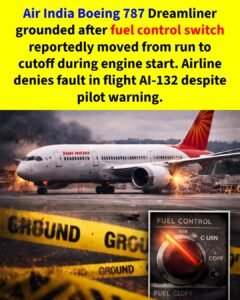
According to an Air India spokesperson, a Boeing 787-8 Dreamliner was grounded after its left fuel switch failed to remain in the ‘run’ position on two occasions and moved to ‘cutoff’ during engine start-up. Reuters, citing sources, reported that the pilot observed the switch slipping out of position when pushed down slightly, indicating that it did not lock properly. The aircraft involved, registered as VT-ANX, is nine years old. Boeing states that such aircraft can operate for around 30 years before enhanced maintenance checks are required, with a potential service life extending up to 50 years.
The latest incident has brought renewed attention to the Ahmedabad crash. Captain C.S. Randhawa, President of the Federation of Indian Pilots (FIP), on Monday urged the Directorate General of Civil Aviation (DGCA) and the Aircraft Accident Investigation Bureau (AAIB) to immediately probe possible electrical faults in Boeing 787 aircraft.
Captain Randhawa said this was the third known instance of uncommanded movement of fuel control switches on a Boeing 787. He cited an earlier incident involving an ANA Boeing 787-800 aircraft at Osaka on February 17, 2019, where both fuel control switches reportedly moved to the cutoff position automatically due to an electrical malfunction when throttles were brought to idle during landing. “We have been relating the same theory for the Air India 171 crash on June 12 at Ahmedabad,” he told news agency ANI.
Following the Ahmedabad crash, the DGCA had directed airlines to inspect the locking mechanism of fuel cutoff switches. The preliminary investigation report also referred to a 2018 advisory by the US Federal Aviation Administration, which recommended—but did not mandate—inspection of the locking feature of fuel cutoff switches on several Boeing models, including the 787.
Air India informed investigators that it had not conducted the FAA-recommended inspections at the time since the advisory was not mandatory. However, the airline said maintenance records showed that the throttle control module, which houses the fuel switches, was replaced in 2019 and again in 2023 on the aircraft involved in the crash. The report stated that “all applicable airworthiness directives and alert service bulletins were complied with on the aircraft.”
A final investigation report is still awaited. How both fuel switches transitioned from normal operation to the cutoff position remains the central unanswered question, with possibilities ranging from mechanical failure and electronic malfunction to human error. The preliminary report noted that the cockpit voice recorder captured one pilot questioning the fuel cutoff, while the other denied responsibility. In response, the DGCA ordered mandatory FCS inspections on nearly all Boeing aircraft operating in India.
As of now, Air India operates 33 Boeing 787 Dreamliners, according to data from Flightradar24. Boeing said it is in contact with Air India and is supporting the airline’s review of the issue, while Honeywell had not responded to queries from CISREV at the time of publication.
Commenting on the situation, Captain Amit Singh, founder of the Aviation Safety Matters Foundation, said: “While no connection is implied, the repeated emergence of issues with a critical flight control system on the same aircraft type demands the highest level of scrutiny. This discrepancy raises urgent questions—were the checks thorough, or is this a recurring defect? Passengers and crews deserve clear and unambiguous answers.”