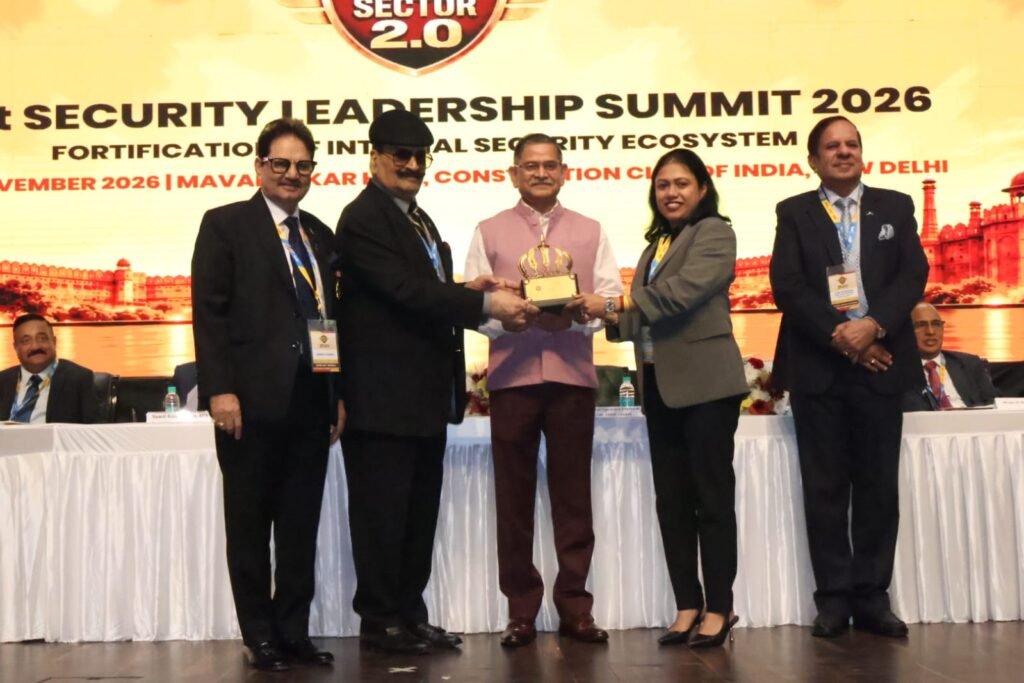

Former Army Chief General Upendra Dwivedi has called for greater integration of India’s private security industry into the country’s national security framework, describing more than one crore private security personnel as the nation’s “first sensor network”.
Addressing the 21st Annual Security Leadership Summit organised by the Central Association of Private Security Industry (CAPSI) in New Delhi on Friday, General Dwivedi thanked Shri Kunwar Vikram Singh, Chairman of CAPSI, for inviting him to address the gathering. The summit brought together private security industry leaders, government officials, former military officers and representatives of security agencies.
General Dwivedi said private security personnel guarding factories, power plants, coal mines, hospitals, ports, data centres and residential complexes were an important but often overlooked component of India’s security architecture.
According to industry estimates cited by him, more than one crore people work in the private security sector across over 35,000 agencies. Referring to figures cited by the Union Home Minister in 2019, he said India then had approximately 90 lakh private security guards compared with around 30 lakh police and central armed police personnel.
Drawing a parallel with the armed forces, the former Army Chief described private security guards as the first line of detection against potential threats. He said their presence at critical infrastructure facilities and public establishments gave them an important role in identifying suspicious activities and reporting security concerns.
He said the nature of modern warfare was changing, with threats emerging not only in the physical domain but also in the digital space and through psychological operations. Misinformation, radicalised individuals, compromised insiders and cyber vulnerabilities were among the emerging security challenges.
Referring to an attack on two private security guards at an under-construction building in Mira Road near Mumbai on April 28, he said security personnel themselves could become targets. He stressed the need for better training, rapid communication systems and coordination with police and emergency services.
Outlining his vision for what he called Private Security 2.0, General Dwivedi identified three priorities: pride, professionalism and partnership.
On professional recognition, he advocated certification of experienced security guards through the Recognition of Prior Learning system, acknowledging skills acquired through years of practical experience. He also welcomed the Guarding Officer initiative, saying new designations must be backed by recognised qualifications, defined responsibilities and opportunities for career progression.
He emphasised that professional recognition must go hand in hand with better wages, provident fund benefits, insurance and accident coverage. Calling on companies and institutions hiring private security agencies to look beyond the cheapest bids, he said professional competence and quality should be given priority.
On technology, General Dwivedi encouraged the industry to adopt artificial intelligence and modern security solutions, while cautioning that machines should assist rather than replace human judgement. He said security personnel must be retrained as technology changes their responsibilities, and that data collected through surveillance and digital systems must be protected against misuse.
He also called for stronger cooperation between private security agencies, police, fire services, civil defence and government departments, including joint exercises and specialised training in first aid, firefighting, evacuation, disaster management and countering emerging threats such as unauthorised drones.
Concluding his address, General Dwivedi urged the private security industry to ensure fair wages, professional training and dignity for its workforce. He said that while the uniform might have changed for former servicemen entering the private security sector, their sense of duty remained unchanged.
He described the transformation from manpower-based guarding to a trained, technology-enabled and professionally recognised workforce as the central objective of Private Security 2.0.