
Just a decade ago, the Sharma family in Ghaziabad carefully planned every household expense. With a single income and limited savings, purchases beyond essentials were postponed. A new refrigerator was a luxury, eating out was reserved for special occasions, and family holidays remained a distant dream.
Today, their story is remarkably different. With both husband and wife employed, higher salaries, easier access to digital payments and consumer credit, and growing confidence about the future, the family has moved into India’s expanding middle class. They recently upgraded to a larger apartment, bought a compact SUV, enrolled their children in online learning programmes, and regularly order groceries and meals through quick-commerce apps. What was once considered an indulgence has become part of everyday life.
The Sharmas are not an isolated example. Their journey mirrors the transformation taking place across millions of Indian households and reflects one of the most significant shifts in the country’s economic landscape—a powerful consumption boom that is reshaping businesses, investment patterns and economic growth.
India’s consumer spending is projected to rise from USD 2.4 trillion in 2024 to USD 4.2 trillion by 2030. This surge is being fuelled by six structural drivers: a young and growing population, rising incomes, rapid urbanisation, widespread digitisation, easier access to formal credit, and an increasing preference for premium products and services.
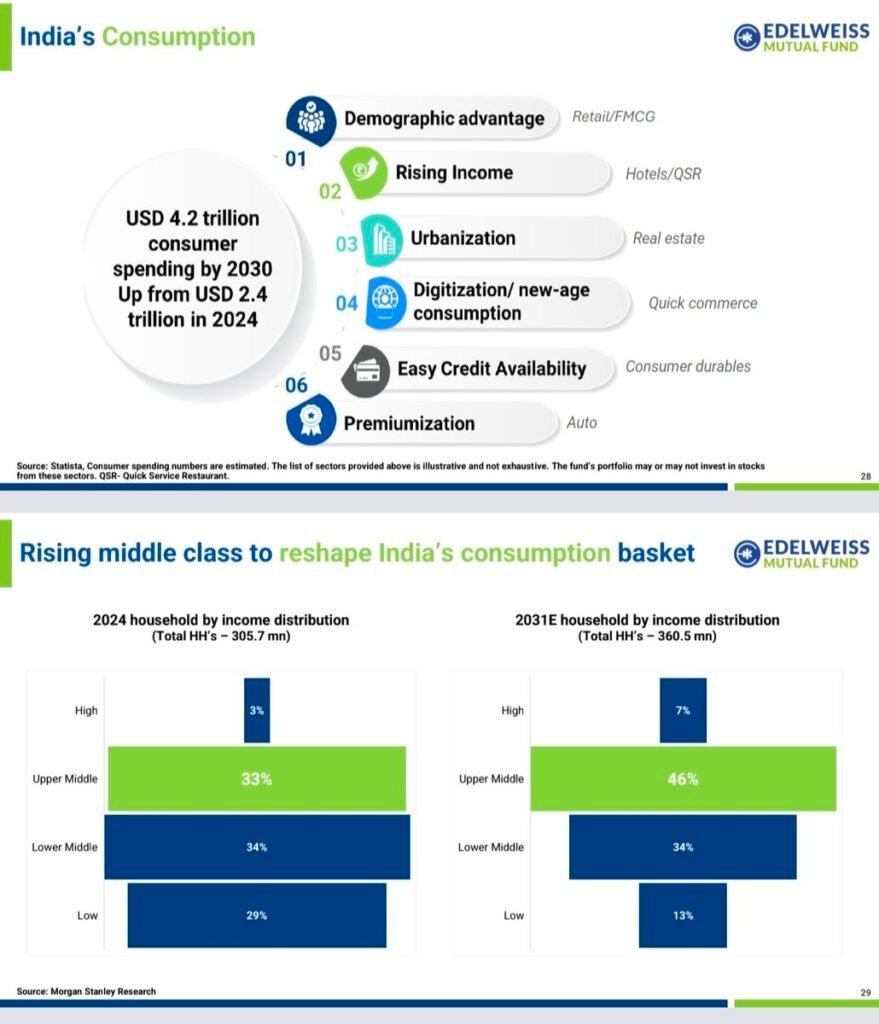
Equally significant is the changing income profile of Indian households. By 2031, upper-middle-income households are expected to account for 46 per cent of all households, up from 33 per cent today. At the same time, the share of low-income households is expected to shrink from 29 per cent to 13 per cent. This shift is fundamentally changing what Indians buy and how they spend.
The impact is already visible across sectors. Organised retail is expanding rapidly, housing demand is moving beyond basic shelter to larger and better-equipped homes, automobile sales are increasingly driven by feature-rich vehicles, domestic tourism is booming, and quick-commerce platforms are redefining convenience. Consumers are also spending more on healthcare, education, financial services, entertainment and lifestyle products.
Unlike earlier consumption cycles that were concentrated in metropolitan cities, the current boom is spreading into Tier-II and Tier-III cities, where rising incomes, better infrastructure and digital connectivity are creating new markets. Affordable smartphones, widespread internet access and the growth of digital payment platforms have enabled millions of consumers to participate in India’s formal economy like never before.
Challenges remain. Income inequality, inflationary pressures, job creation and rural demand will continue to influence the pace of consumption. However, the long-term fundamentals remain strong. As more families follow the trajectory of the Sharmas—from cautious spending to confident consumption—India is steadily evolving into one of the world’s largest and most dynamic consumer markets.
For businesses, investors and policymakers alike, the message is clear: India’s next growth story will not be driven solely by what the country produces, but increasingly by what its people aspire to own, experience and consume.