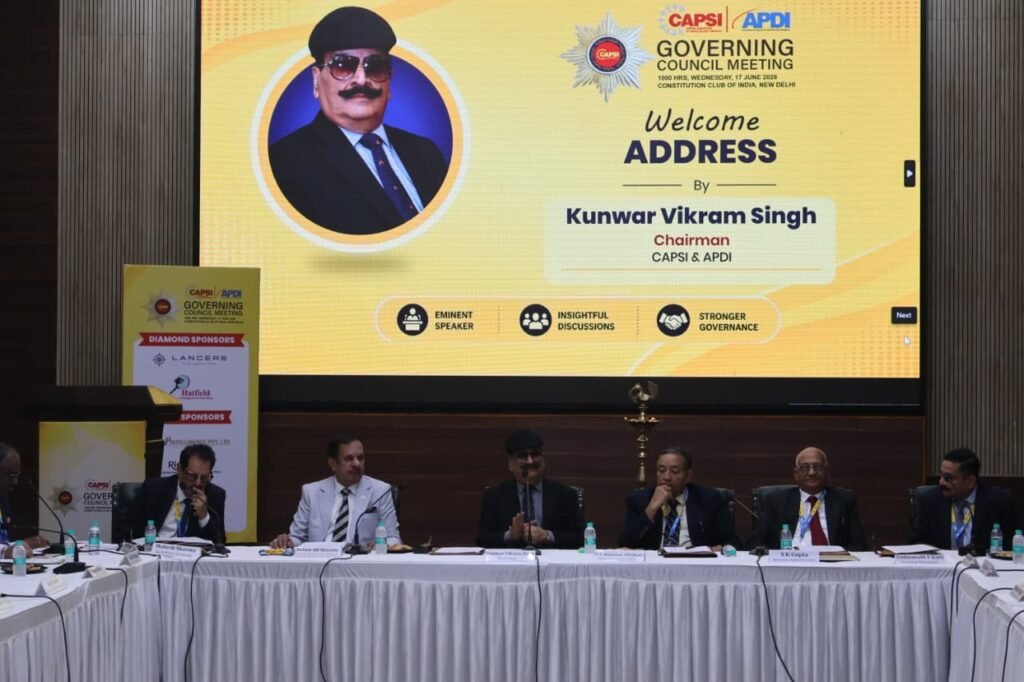

By Kunwar Vikram Singh
Author & Security Analyst
India needs a bureaucracy that is accountable for outcomes, rewards performance and empowers those who deliver.
Bureaucracy has traditionally been regarded as the backbone of governance. India’s civil services attract some of the country’s brightest and most capable young people. Through highly competitive examinations and rigorous selection, the nation identifies individuals with intelligence, aptitude and leadership potential and entrusts them with enormous responsibility.
But a difficult question needs to be asked today: Are we getting the best out of the people we select to govern?
The concern is not about the commitment or integrity of the vast majority of civil servants. Many officers work with extraordinary dedication under difficult circumstances. The concern is about a system in which competence, performance and outcomes do not always determine responsibility, recognition and advancement.
That is where the real governance challenge lies.
From Selection to Performance
India has one of the most competitive civil-service selection systems in the world. But selecting talented people is only the beginning. What happens after selection matters equally.
In organisations such as the armed forces, progression is closely linked to demonstrated competence, leadership, professional knowledge and performance. An officer is continuously assessed before being entrusted with greater responsibility.
Governance requires no less.
Yet in the administrative system, the link between performance and progression can sometimes become blurred. Seniority, postings, organisational dynamics and administrative considerations can carry considerable weight alongside actual outcomes.
This creates an uncomfortable possibility: a person may enter the system as exceptional, but the system does not necessarily ensure that he or she remains exceptional in public responsibility.
This is where the familiar Peter Principle—the tendency for people in hierarchical organisations to rise to a level at which they may no longer be effective—becomes relevant.
The issue is not whether the principle applies to every officer. It is whether our system has sufficient safeguards to ensure that it does not.
The Cost of Getting Leadership Wrong
The higher the administrative position, the greater the consequences of ineffective leadership.
A weak decision at the lower level may affect a department. A weak decision at the senior level can affect an entire state, sector or national programme.
When leadership positions are occupied without sufficient emphasis on demonstrated capability for that particular responsibility, the consequences can include:
- Delayed decisions
- Excessive proceduralism
- Lack of accountability
- Poor implementation
- Reluctance to innovate
- Loss of institutional initiative
- Policies that look excellent on paper but fail on the ground
Ultimately, it is the citizen who pays the price.
The Problem of the Good Officer
There is another issue that deserves attention.
What happens to an officer who challenges conventional thinking, takes difficult decisions, introduces reforms or delivers exceptional results? Does the system consistently recognise such performance? Or can such officers sometimes become inconvenient because they disturb established processes and vested interests?
If capable officers are repeatedly moved away from positions where they are delivering results, while mediocre performance carries little consequence, the message to the entire organisation can be damaging.
A system teaches its people what it rewards.
If it rewards only survival, conformity and procedural compliance, people will learn to minimise risk. If it rewards innovation, responsibility and results, people will learn to lead.
Procedure Must Serve Governance—not Replace It
India has made remarkable progress in technology, infrastructure, entrepreneurship and economic ambition. But parts of our administrative culture still carry the legacy of a system designed primarily to control, rather than facilitate.
Files move. Opinions are sought. Approvals are repeated. Responsibility can become diffused.
When something goes wrong, the system often asks:
“Was the procedure followed?”
The more important question should be:
“Did the decision achieve the intended public outcome?”
Rules and procedures are essential. They protect institutions against arbitrariness and corruption. But procedure should be a means of achieving good governance—not an excuse for avoiding decisions.
India Needs a Performance-Oriented Civil Service
The answer is not to weaken bureaucracy. It is to strengthen it through accountability and meritocracy.
India needs a system in which every senior public servant is assessed not merely on whether files were processed, but on what changed because of his or her leadership.
Performance assessment should increasingly consider:
Results achieved + Quality of decisions + Leadership + Innovation + Integrity + Public impact
This does not mean reducing governance to numbers. Some responsibilities are difficult to quantify. Crisis management, institution building, policy formulation and maintaining social stability require judgement.
But that is precisely why professional assessment by informed peers and independent evaluators becomes important.
Learn From the Armed Forces
The Indian Armed Forces offer valuable lessons.
Leadership is treated as a professional responsibility. Performance is observed continuously. Competence matters. Training is continuous. Responsibilities increase only when an officer demonstrates the ability to handle them.
There is also an important concept embedded in military culture: command is earned through demonstrated capability.
Civil administration should develop an equivalent culture. A senior position should not merely be the next step in a career. It should be an assignment of greater responsibility requiring demonstrated capability for that specific role.
An outstanding officer in one field may not necessarily be the best person to lead another. Therefore, postings to critical positions should increasingly consider domain competence and demonstrated achievement, not merely seniority and availability.
Reward the Achievers. Correct the Underperformers.
A healthy institution must be able to do three things:
Recognise excellence.
Correct weakness.
Replace ineffective leadership when necessary.
Without these three, performance management becomes meaningless.
An officer who delivers transformational results should see those achievements reflected in career progression. An officer who repeatedly fails should receive structured performance support and, where necessary, be moved away from responsibilities for which he or she has not demonstrated competence.
This is not punishment.
It is institutional accountability.
The Need for a New Governance Culture
India is now aspiring to become a developed economy and a global power. The complexity of governance is consequently increasing.
We are dealing with artificial intelligence, cyber security, climate risks, urbanisation, critical infrastructure, global supply chains, emerging technologies, economic competition and rapidly changing citizen expectations.
These challenges cannot be managed through administrative routine alone. They require expertise, speed, innovation, accountability and leadership.
The bureaucracy of tomorrow must therefore be very different from the bureaucracy of yesterday.
From Authority to Accountability
Perhaps the most important transformation required is cultural.
Authority should not be seen primarily as a privilege. It should be understood as a responsibility entrusted by the Republic.
The higher the office, the greater the obligation to deliver.
A senior civil servant controls public resources, influences policies and affects the lives of millions. Such authority must therefore be matched by measurable accountability.
Power without performance is dangerous.
Authority without accountability weakens institutions.
Merit without recognition eventually destroys motivation.
A Reform Agenda
India should seriously consider a comprehensive review of its system of civil-service performance and career progression, including:
- Objective and transparent performance evaluation
- Greater weight to measurable outcomes
- Independent assessment for senior appointments
- Domain expertise for specialised positions
- Leadership and management assessment
- Recognition of innovation and successful reforms
- Periodic review of suitability for critical assignments
- Stronger accountability for persistent non-performance
- Greater institutional protection for officers who take bona fide decisions in the public interest
Technology can also help. Governance today generates enormous amounts of data. Properly designed systems can increasingly measure timelines, outcomes, implementation quality and citizen impact.
The objective should not be to create another bureaucratic layer of reporting.
It should be to create better leadership.
India Does Not Have a Shortage of Talent
India does not lack talented civil servants. It has outstanding officers across the country who have demonstrated courage, innovation and commitment and transformed the institutions they lead.
The challenge is to build a system that consistently identifies them, empowers them and gives them responsibility commensurate with their capability.
The country cannot afford to let exceptional talent become frustrated by a system that treats exceptional and average performance alike. Nor can governance depend entirely on whether an individual happens to be posted to a particular position.
Institutions must be stronger than individuals.
That is the real test of administrative reform.
A Call for Reform
This is not a call to weaken India’s bureaucracy. It is a call to restore its finest traditions.
The civil services were created to serve the nation with integrity, competence and impartiality. Those principles remain as relevant today as ever.
But the India of the 21st century requires a bureaucracy that is faster, more specialised, more innovative and—above all—more accountable for results.
We must therefore move from:
Seniority to Suitability.
Procedure to Outcomes.
Authority to Accountability.
Conformity to Innovation.
Career Progression to Performance Progression.
India has invested enormously in selecting some of its brightest citizens for public service. The next reform must ensure that the system gets the best from them.
Good governance is not merely about having capable people in government. It is about ensuring that capable people are empowered, accountable and placed where their capabilities can serve the nation best.