
It is a familiar Delhi morning. Traffic is building up, horns are coming from every direction, and two-wheelers are squeezing through whatever space they can find. For Nishtha Dugan, 22, the journey is a daily reality. A special educator at Shiv Nadar School in Gurgaon, she commutes 60 to 70 kilometres between Delhi and Gurgaon. Today, she is showing me the features of her year-old TVS electric scooter while riding it through Delhi traffic.
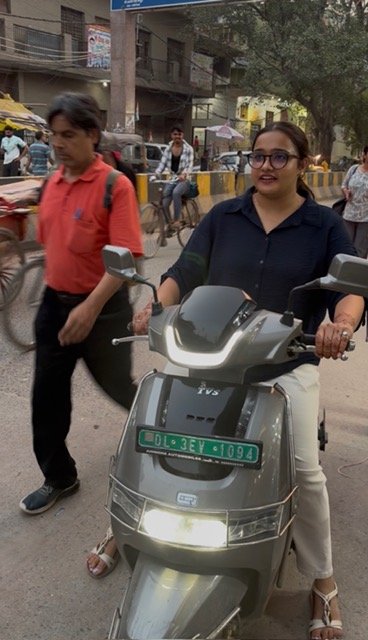
Nishtha Dugan, EV rider: “It has modes like Eco. In Eco it travels 105 kilometres, and in Power it covers 74 kilometres.” The dashboard displays the scooter’s range and other functions, and it can connect to her phone. But for Nishtha, the attraction is much more basic: getting to Gurgaon and back without stopping for petrol. She charges the battery at night and is ready to go the next morning. After switching from a petrol scooter, she says the electric one is more convenient and easier on her pocket.
Nishtha Dugan: “It is eco-friendly also plus it is pocket-wise very convenient for me also. I really like it much better than the petrol Scooty.”In a single night’s charge, she can ride around 80 kilometres. She says that costs her about ₹12 in electricity, compared with around ₹120 a day that she used to spend on petrol. That is a saving of roughly ₹108 a day, or more than ₹3,000 a month if she rides every day. Her experience is personal, but it illustrates why the economics of electric mobility are becoming harder to ignore.
A growing presence on India’s roads
Nishtha is not alone. Across India, electric two-wheelers are becoming increasingly visible. In the financial year 2025–26, India sold around 1.4 million electric two-wheelers, according to Vahan-based industry data. Electric two-wheelers accounted for more than half of all EV sales in the country.
Delhi is also seeing a rise. In July this year, more than 10,700 pure electric vehicles were registered in the capital—the highest monthly figure of 2026 at that point.So, why are people making the switch? Is it about the environment? Government incentives? New technology? Or is it simply about money? For many everyday riders, the answer may be much more practical: how much does it cost to run the vehicle every day, and how much does it cost to maintain?
The economics of the EV
Sharif Qamar, who leads the Transport and Urban Governance team at The Energy and Resources Institute, TERI, has been driving an EV himself for several years. He says consumers should not look only at the price they pay when buying the vehicle.  “EVs in terms of upfront cost are still slightly expensive. People are shifting to EVs not only because of the fuel cost, but there are multiple factors… If you look at the overall life of 15–20 years of an EV, EVs start giving you back in terms of overall savings in terms of fuel, in terms of maintenance.”The initial price of an electric vehicle can still be higher than a conventional petrol vehicle. But the calculation changes if the vehicle is driven every day particularly over long distances.
Sharif Qamar: “If you are running 70–80 km per day or 100 km per day and taxi is running more than 300 km per day, it makes a lot of sense for these people to shift to electric vehicles because… the more you run an EV, the better return that it will give you back.” For someone who drives only occasionally, the calculation may be different. But for a commuter covering tens of kilometres every day—or a taxi driver travelling hundreds of kilometres—the economics become much more compelling.
A few kilometres away, in the densely populated lanes of south Delhi, Harbir Singh has reached a similar conclusion.Harbir, 45, is a real estate agent in Deoli, on the outskirts of south Delhi, catering largely to lower-middle-class homebuyers. For eight years, he rode a petrol Hero Splendor. A few months ago, he switched to an electric scooter.

He travels around 50 to 60 kilometres a day. He charges it at home at night, and for him, the attraction is simple: less money spent on fuel and no regular visits to a petrol station. Harbir Singh: “I have nothing to do with petrol. I don’t go to the petrol station. I like driving it.”He says he enjoys the scooter, finds it good-looking, and feels it has made electric mobility accessible to him, he added “There is no expense in lakhs. Yes, there is nothing. There is no operating cost. There is nothing.”His experience reflects another side of the EV transition—the attraction of avoiding petrol altogether and reducing the day-to-day cost of running a vehicle.
The oil question
India imports around 90 percent of the crude oil it consumes, making the country vulnerable to international oil-price shocks.And this year, the Iran conflict and instability around the Strait of Hormuz have again pushed energy security into the spotlight. Brent crude moved above 90 dollars a barrel at the end of August as tensions escalated.For Indian motorists, global geopolitics can eventually become a very local question: How much will it cost to fill the tank? Sharif Qamar: “So, of course, the Iran war and the conflict in the Middle East has really shifted people not only to EVs, but also CNG in that sense.” The point is not that every motorist will immediately switch to electric. It is that fuel-price volatility can make the running-cost advantage of an EV more attractive.
Delhi’s EV push
But Qamar says the longer-term objective is bigger than simply avoiding expensive petrol. Delhi is also trying to push that transition towards zero tailpipe emissions.The new Delhi Electric Vehicle Policy 2026 came into effect on July 1, with incentives, tax-related measures and plans to expand charging infrastructure. EV registrations rose to more than 10,700 in July. But incentives alone cannot make people buy electric vehicles. The vehicle has to work for them. It has to be affordable. It has to have sufficient range. And, perhaps most importantly, people need somewhere to charge it.
Charging: the practical test
For Nishtha and Harbir, charging is not a major problem because they can charge their vehicles at home.
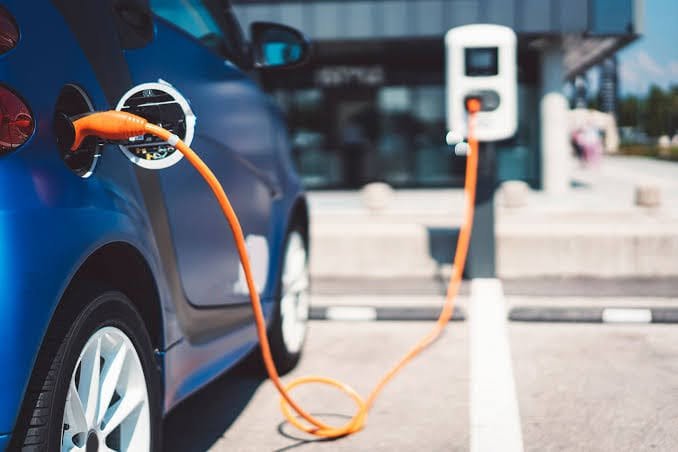
That is actually the case for most private EV owners. Qamar says more than 90 percent of private EV owners charge at home, making residential charging particularly important.Sharif Qamar: “For a private vehicle owner in the EV sector, what we are seeing is more than 90-95% of EV owners are charging their vehicles at home. Therefore, the priority of the government and the authorities on ground should be and is related to ensuring that these private owners or prospective buyers of EVs have access to charging points at their own parking.”But public charging remains important for people who cannot charge at home—and for commercial vehicles travelling long distances. Sharif Qamar: “Chargers are increasing, but it is still not sufficient. The number, quality and uptime need to improve.” That is a reminder that the economics of an EV depend not only on the vehicle itself, but also on the infrastructure around it.
So, is the EV making economic sense?
Back on the scooter, Nishtha is less interested in the big policy debate.Her calculation is straightforward. She has a daily commute. She needs a reliable vehicle. She wants something easy to ride. And she does not want to spend her morning looking for a petrol pump. For commuters like Nishtha and Harbir, it is about convenience and cost.For a country heavily dependent on imported oil, electric mobility also offers a way to reduce exposure to volatile global energy prices.But there are still obstacles.The upfront cost remains higher for many vehicles. Charging infrastructure needs to improve. Battery technology and domestic manufacturing have to develop further. And consumers still need confidence that an EV will perform reliably over many years. The EV is not automatically the cheapest choice for everyone.But for people who drive long distances every day, charge at home, and keep their vehicles for years, the calculation is increasingly clear: The question is no longer simply, “Can I afford an electric vehicle?” It is, “Can I afford to keep running a petrol vehicle?”